Almost everyone has heard of dental implants, but like other dental treatments, they can be confusing. An implant replaces a missing tooth, but did you know that replacing a missing tooth is a three-step process? Also, did you know that implants are sometimes placed in order to secure dentures? In this month’s blog, Dr. Ross, a Loveland, CO, dentist explains all the pros and cons of dental implants.
When someone is missing a tooth anywhere in the arch, that tooth can be replaced by a dental implant. The implant itself replaces the root structure of the tooth and goes into bone. Once the implant has integrated with the bone, usually 3-6 months later, a dental implant abutment is attached to the implant. The abutment is a connector piece from the crown to the implant. The third piece to a fully restored implant is the implant crown. The crown is the part you will see in your mouth.
If a person has an existing denture or if a person is considering full dentures as their best treatment option, implants can help tremendously. Implants help to maintain existing bone levels and will actually help keep the denture from rocking. The implants are firmly placed into the bone, and the denture then snaps onto the implants. There are a lot of different options for dentures and implants. If this is an option that you think might be best for you, make sure you talk to your Dentist!
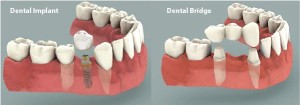
dental implants vs bridge
2. Implants never get decay. They can still, however, get bone loss. That’s why it is still very important to get your teeth cleaned and checked to make sure that tarter or calculus is removed.
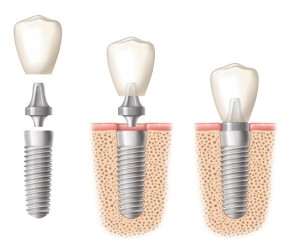
Parts of an implant
3. Implants typically last longer than a bridge, partial or denture. When the implant is properly maintained with healthy and regular oral hygiene, bone level is actually maintained too. Whenever there is a missing tooth, the body does not maintain the bone level in that area. This causes the bone to recede which results in partials/dentures not fitting as well. Also, bridges have a higher chance of failure due to decay or gum recession and bone loss.
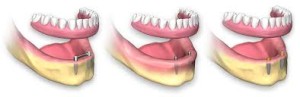
picutre of an over-denture.
Implants might seem expensive at first; however, from start to finish, placing implants takes place over time and procedures are broken into multiple appointments. Everyone’s needs are different, but when you think about the possibility of more time and money going into replacing partials/dentures or bridges multiple times throughout your lifetime rather than replacing the tooth once with an implant, the cost is not comparable. The bridge and partial/dentures would be a lot more expensive than the onetime cost of an implant. If you are considering an implant as an option, contact your Dentist. Dr. Ross at Ross Family Dentistry would love to help you now and with all your future needs!